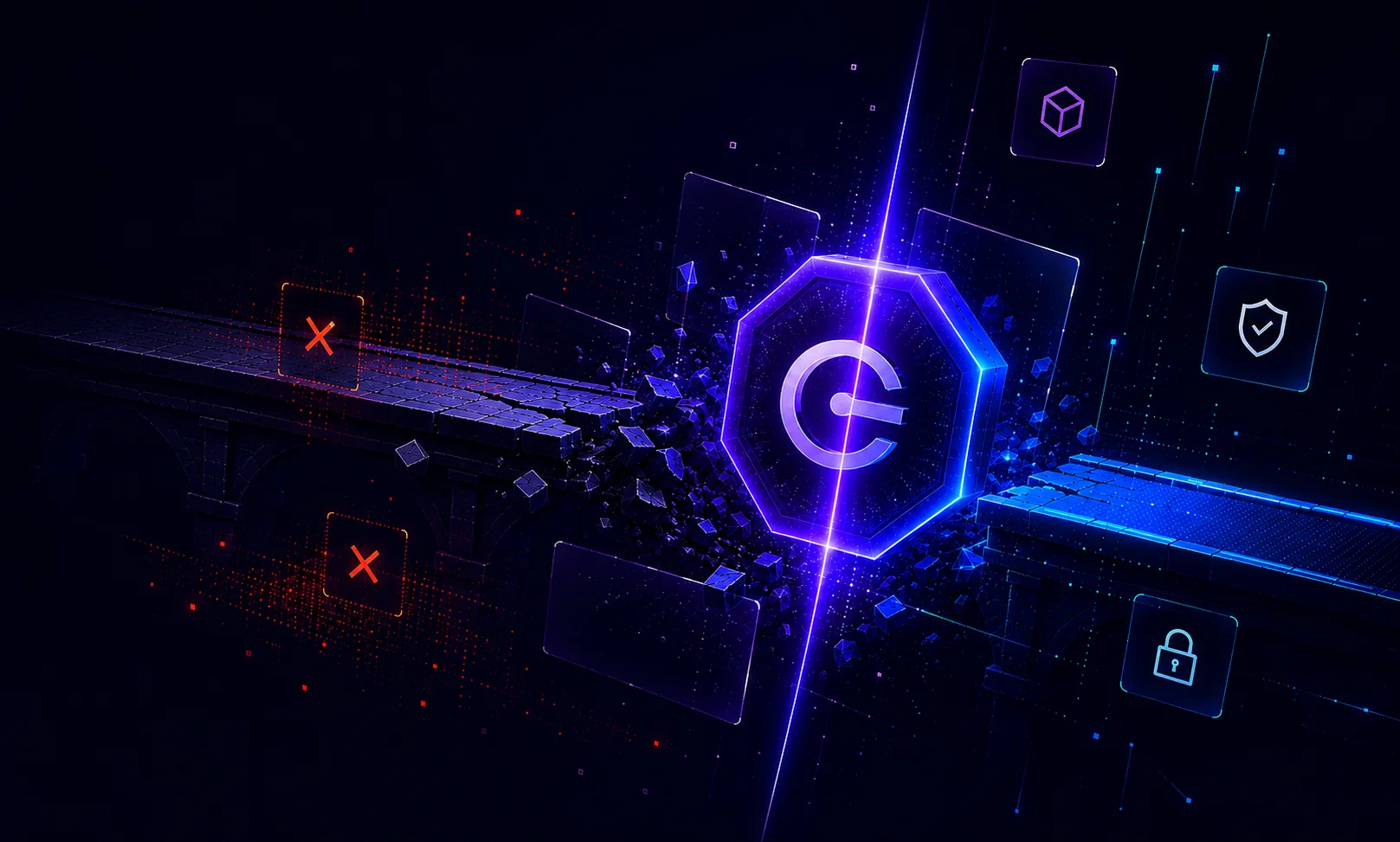
Cross-chain is broken.
USC fixes it.

Bridges get hacked. Centralized oracles can be corrupted or go offline. Both create single points of failure that put your users' funds at risk. Universal Smart Contracts eliminate trust assumptions entirely, your contracts natively verify cross-chain data using cryptographic proofs, not intermediaries.

The market accepted a bad trade-off.
You don't have to.

For years, cross-chain meant choosing between security and functionality. USC removes that choice.

The old way, bridges & oracles

Trust someone else.
Hope they don't fail.

  • Single point of failure One compromised operator or bridge contract puts every user's funds at risk
  • Billions lost to bridge hacks The most exploited surface in crypto because the architecture is the vulnerability
  • Centralized oracle manipulation A single operator can corrupt data, halt the system, or be coerced
  • Async, multi-step flows Users wait 10–30 minutes and must sign multiple transactions across chains
  • Opaque trust models Developers can't verify what they're trusting or why
The USC way, native decentralized oracle

Trust math, not
middlemen.

  • No single point of failure Trust distributed across Creditcoin's decentralized oracle network
  • Cryptographic certainty Merkle proofs + continuity proofs verify transaction inclusion with mathematical guarantees
  • Tamper-proof by design Any modified block cascades through the digest chain and is immediately detectable
  • Synchronous, one-block verification ~15 seconds, same transaction, users sign once
  • Fully auditable Every proof step is verifiable on-chain, no black boxes

Cross-chain verification,
measured honestly.

Most bridges measure latency in minutes. USC verifies in a single block. For users, that's the difference between waiting for a bus and pressing a button.

Traditional bridge10–30 min
Optimistic bridge (fraud window)up to 7 days
Centralized oracle1–5 min
USC, Creditcoin~15 seconds
// time to cross-chain verification after source block finalization

Four components.
One trustless flow.

USC is built into Creditcoin's runtime, not bolted on. The oracle infrastructure is native, which means verification runs as compiled Rust code at the protocol level.

Trustless by default

No operator keys to compromise. Proofs are verified mathematically, if they pass, the data is real. If they don't, the transaction reverts.

Synchronous execution

Verification and business logic execute in the same transaction. No async callbacks, no multi-step UX, no waiting for confirmations.

EVM-native

Write Solidity. Use Hardhat, Foundry, your existing toolchain. No new languages, no vendor lock-in, no migration overhead.

Batch verification

Verify up to 10 cross-chain queries in a single transaction with a shared continuity proof. Efficient at any scale.

01

Deploy

Your Source Chain Contract handles source-side logic and emits events with the data you need cross-chain.

e.g. Ethereum
02

Prove

Your Oracle Worker monitors events, waits for attestation, and auto-generates Merkle + continuity proofs.

off-chain automation
03

Verify

Your USC on Creditcoin calls the native precompile. Proofs verified cryptographically in the same transaction.

~1 block / ~15s
04

Execute

Business logic fires immediately. Users sign once. The worker handles retries, deduplication, and proof formatting.

seamless UX

Four tracks. Infinite applications.

USC is general-purpose, any use case involving cross-chain data is fair game. Here's where developers are already building.

DeFi

Cross-chain finance

Access liquidity and users across every supported chain from a single contract. Build lending, borrowing, yield, and trading applications without trusting a bridge to move assets.

PerpetualsDerivativesLiquid stakingCross-chain bridgesYield aggregators
RWA

Real-world assets

Tokenize, finance, and manage real-world assets on Creditcoin. USC gives you the cross-chain data layer to bridge off-chain value with on-chain transparency, the way Creditcoin has operated since 2017.

TokenizationTreasury mgmtStablecoinsReal estateCredit markets
DePIN

Decentralized infrastructure

Build coordination layers for physical infrastructure networks, IoT, telecom, storage, satellite. Use Creditcoin for incentives, service verification, and settlement across networks.

IoT coordinationSatellite networksTelecomStorage proofsNode rewards
Gaming

On-chain game economies

Power in-game asset ownership, player-driven economies, and cross-chain item portability. Give players real ownership of in-game assets that exist and are verifiable across chains.

In-game assetsCross-chain itemsPlayer economiesSocial platformsNFT marketplaces

Build first.
Commit later.

You don't need to apply for anything to start building. Get testnet CTC from the faucet in our Discord, spin up the tutorial, and have a working cross-chain dApp running before you've filled out a single form.

1

Join Discord & get testnet CTC

Head to the 🚰 faucet channel and request CTC tokens. Free, instant, no KYC.

2

Explore the video tutorial series

Watch the videos, then clone the example repo and deploy your first USC. A working cross-chain bridge from Sepolia to Creditcoin testnet takes under an hour.

3

Ready to ship?

When you're ready to go live, CEIP can fund your journey and prepare you to launch to our active ecosystem community.

// Start here

Get testnet CTC & start building

// No account required. Testnet tokens are free.

From testnet to funded.
We back builders.

When you're ready to move beyond testnet, two programs accelerate the path from idea to funded, launched product.

Competitive path

BUIDL CTC
Hackathon

Creditcoin's hackathon series across 4 tracks: DeFi, RWA, DePIN, and Gaming. The top 3 teams fast-track directly into CEIP, bypassing initial screening and going straight to due diligence.

  • 4 build tracksDeFi, RWA, DePIN, Gaming
  • Fast-track to CEIPFor the top 3 teams
  • Skip initial screeningGo direct to due diligence
  • Build in publicWith the Creditcoin community behind you
Enter BUIDL CTC →

The docs are live.
Start building today.

Everything you need to deploy your first Universal Smart Contract is in the docs. Join Discord to get testnet tokens and ask questions in real time.